A program of EffectiveSC

How We Use AI

Sources checked October 24 to 29, 2026

AnalysisHow much will companies spend checking AI agents' work? →

Where things stand / AI added to products you already use

AI added to products you already use

What people do with AI inside the software they already use, what the companies selling it publish, and what those numbers leave out.

Before you read on

Robb Wilson, who leads this research, works at OneReach.ai, which sells agent orchestration software, and EffectiveSC, which publishes How We Use AI, plans to offer AI services of its own. This page's judgment, that the software companies already run is becoming the layer agents work through, sits close to that business. The podcast accounts are what people said about products their own companies sell or run, and the judgment is this site's reading of the evidence, not a measurement. Claude, Anthropic's AI, helped compile this research, and cards that cite Anthropic's products say so.

See also: Who publishes How We Use AI, What else we plan to sell or offer

What people do with it

The clearest view of use inside a product people already have is Microsoft's own study of prompts to the chat in its office suite: most ask it to find information or to rework text they already have. Beyond that study, a probability poll shows where people reach Microsoft's assistant: most of its users reach it inside the apps they already work in.

28.5%

Between June 1 and September 22, 2025, Information Inquiry fell from 38% to 33% of Microsoft 365 Copilot Chat user intents, while Content Refinement rose from less than 22% to 28.5%.

Shares of the mix, not amounts: a smaller share of requests to look things up doesn't mean fewer of them.

Disclosure: Microsoft's researchers studied Microsoft's own product.

Counts et al. (Microsoft), AI in the Enterprise: How People Use M365 Copilot Chat, arXiv 2605.23958 · June 1 to September 22, 2025 · Grade B

61%

In a March 2026 probability-panel poll of 2,021 US adults, 61% of Microsoft Copilot users said they access it within products like Word, Excel or Teams, and 47% of Google Gemini users see AI summaries in search results; 75% of AI users type prompts directly. Among those using AI for work, 50% rely solely on personal subscriptions or free access and 33% use an employer-provided AI service.

Who was asked: 2,021 US adults, Ipsos KnowledgePanel (probability-based, weighted)

The share is of Microsoft Copilot users, about one adult in nine, not of all AI users, and the poll doesn't separate Microsoft's office suite from its free Copilot app.

Ipsos, "New Epoch AI/Ipsos poll reveals high AI engagement, diverse use cases, and emerging workplace integration", April 13, 2026 · March 3-6, 2026 · Grade A

See also: Tasks AI is doing

What the companies publish

Software companies add AI in three main ways: inline, suggesting the next step inside the tool; as a chat beside the work, in a panel of the same suite; and as a paid seat on top of the old license. Others put an assistant or agent inside the product itself, in a help desk, an app or a store. Each company counts in its own unit, such as seats, paid users, adopters, acceptances or resolutions, and the units don't add up. A seat sold is not a seat used, and having used a feature once is not coming back to it.

62.1%

62.1% of engaged Copilot Business and Enterprise users are still primarily engaging with code completions; across thousands of enterprises, average merged pull requests were 78%, 41% and 151% higher from code first to agent first, agent first to multi-agent, and code first to multi-agent.

GitHub sorts engaged users by how they used Copilot over the past four weeks, and its code-first group includes agent mode inside the editor. The gains compare people already in each group, not the effect of moving them.

Disclosure: GitHub's own telemetry about its own product.

GitHub, 'From code completions to agents: what AI adoption is really worth' (Copilot impact dashboard) · July 22, 2026 · Grade B

about 28%

Alibaba's head of code platform said its internal coding tools had about 12,000 daily active users and about 65% penetration inside the group, with completion acceptance about 28% overall and about 33% in IntelliJ IDEA; about 20% of the issues raised in code review were generated by AI.

The unit is completion suggestions accepted, in one company's internal tool, as one engineering lead told it in a talk that InfoQ edited. He said generated code that was only mostly complete raised the cost of use and hurt retention, and he gave no retention rate.

Cited secondary · Xiang Bangyu (Alibaba), 'From Copilot to general agents: Alibaba's AI coding applications and challenges', QCon; InfoQ edited transcript · June 30, 2025 · Grade C

184%

Zoom said AI Companion paid users grew 184% year over year in the quarter ended April 30, 2026, and My Notes reached 1.5 million licensed users within four months of launch; in the quarter ended July 31, 2026, Zoom Virtual Agent's customer count rose 256% year over year.

Three units: paid users, licensed users and customers. None is a usage or retention rate, and no base is given for the growth.

Zoom Communications, first- and second-quarter fiscal 2027 results releases · Q1 FY2027 (ended April 30, 2026), released May 21, 2026; Q2 FY2027 (ended July 31, 2026), released August 25, 2026 · Grade C

over 80%

Atlassian said over 80% of Fortune 500 companies now use Rovo, Rovo-assisted actions rose over 50% from the prior quarter, Rovo adopters complete 20% more Jira work items and create or edit 25% more Confluence pages than non-adopters, and grow their ARR more than 2x faster.

Use of Rovo isn't defined, and the comparisons set customers who chose Rovo against those who didn't, so they show selection as much as effect.

Atlassian, shareholder letter, Q4 fiscal 2026 · shareholder letter dated August 6, 2026 · Grade C

over 30 million

Microsoft reported over 30 million paid Microsoft 365 Copilot seats and nearly 40 million agents registered in Agent 365 (July 2026).

The unit is paid seats, which are bought, not necessarily used. Agents count when they are registered, not when they work.

Microsoft FY26 Q4 earnings, July 29, 2026 · reported July 29, 2026 · Grade C

one in 15

Microsoft reported 15 million paid Microsoft 365 Copilot seats and over 450 million paid Microsoft 365 commercial seats in January 2026, over 20 million Copilot seats in April and over 30 million in July 2026; on those figures Copilot covered roughly one paid commercial seat in 30 in January and one in 15 in July (project arithmetic).

This site's arithmetic from Microsoft's own seat counts, each of them a floor. Paid seats are not use.

Estimate · Microsoft, FY26 Q2, Q3 and Q4 earnings conference calls · January 28, April 29 and July 29, 2026 · Grade C

99%

Adobe said 99% of Fortune 100 companies have used AI in an Adobe app, and nearly 90% of its top 50 enterprise accounts have adopted one or more of its AI-first innovations, including GenStudio for Performance Marketing, Firefly Services and Acrobat AI Assistant.

The unit is companies that have used AI in an Adobe app, not companies that kept using it.

Adobe, 'Global Enterprises Embrace Adobe and its AI Innovations to Power Growth' · September 11, 2025 · Grade C

70%

HubSpot's product page states a 70% average resolution rate for its customer agent (top teams hit 90%), and says customers using it close 74% more tickets and have an 84% higher ticket resolution rate, on average; it charges $0.50 per resolution.

HubSpot's own unit: a resolution is a conversation not handed to a person for three days, or a qualified lead. The page gives no base, period or comparison group.

Disclosure: HubSpot sells the agent and published these figures on its product page.

HubSpot, AI customer agent product page · Product page, undated; read October 29, 2026 · Grade C

nearly 45%

Airbnb said over 40% of issues for guests who contact support through its AI Assistant were resolved without a human agent in Q1 2026, up from roughly a third in Q4 2025, and nearly 45% of issues that begin with the assistant in Q2 2026; customer-support cost per booking fell about 16% year over year in Q2.

The base is issues that start with the assistant, not all support contacts.

Airbnb, Q1 and Q2 2026 shareholder letters · Q1 2026 letter, May 7, 2026; Q2 2026 letter, August 6, 2026 · Grade C

250 million

Amazon said 250 million customers used Rufus in 2025 and shoppers using it were 60% more likely to complete a purchase; in Q2 2026 Alexa for Shopping's active users close to doubled and interactions rose over 5x year over year, and US customers who use it spend over 40% more per order than those who don't.

Shoppers who use the assistant differ from those who don't before they open it, so the purchase and spending gaps are comparisons, not effects. Amazon defines no active user and gives no base.

Amazon.com, quarterly results releases (Q3 2025, Q1 2026, Q2 2026) · Q3 2025 release, October 30, 2025; Q1 2026 release, April 29, 2026; Q2 2026 release, July 30, 2026 · Grade C

Shopify said its LLM judges for Sidekick improved from a Cohen's kappa of 0.02 to 0.61 against human judgment, compared with a human baseline of 0.69; it publishes no acceptance or resolution rate for Sidekick.

This measures how well Shopify's grader agrees with people, not how often merchants accept Sidekick's work, which Shopify doesn't publish.

Shopify Engineering, 'Building production-ready agentic systems: Lessons from Shopify Sidekick' · August 26, 2025 · Grade C

Old tools or new

People mostly add AI on top of the tools they have. Developers switch AI coding tools fast while their editor stays, and few build software to replace what they pay for. More adults meet AI inside search than in a chatbot, but at work the chat window is still the tool most AI users name. No survey yet asks which tools people stopped using.

70.9%

Among respondents who answered the coding-agent question (n = 12,255), 65.5% had used Claude Code and 58.7% GitHub Copilot in the past year; 70.9% of respondents to the editor question (n = 13,193) used Visual Studio Code regularly, and 14.9% Cursor.

An opt-in survey of Stack Overflow's community. Each share is of the people who answered that question: coding agents used in the past year, editors used regularly.

Disclosure: Claude Code is Anthropic's product, and Claude, Anthropic's AI, helped compile this research.

Stack Overflow, 2026 Developer Survey: AI and technology sections, full data · Fielded June 23 to August 5, 2026 · Grade C

about 39%

In JetBrains' weighted developer surveys, Claude Code use at work rose from about 3% (April to June 2025) to 18% (January 2026) and about 39% (May to July 2026), while GitHub Copilot fell from 29% to 21% and Cursor from 18% (January 2026) to 12%. In May to July 2026, 90% of professional developers used AI coding agents at work at least weekly, and 68% daily.

Weighted surveys of professional developers by JetBrains. Each share is of developers using the tool at work.

Disclosure: JetBrains sells developer tools and AI agents, and Claude Code is Anthropic's product; Claude, Anthropic's AI, helped compile this research.

JetBrains Research blog, "Which AI Coding Tools Do Developers Actually Use at Work?" (April 2, 2026) and "AI Coding Agents: Adoption Trends" (August 19, 2026) · April to June 2025; September 2025; January 2026; May to July 2026 (posts of April 2, 2026 and August 19, 2026) · Grade C

64.1%

64.1% of respondents say AI has made them visit Stack Overflow less for simple questions, 28.9% ask fewer questions and 15.9% visit more for verification; asked which actions they turn to first for answers (top three), 82.7% chose online search and 69.9% asking an AI agent.

One old tool losing simple questions, not old tools in general. Asked where they look first, more chose online search than an AI agent.

Disclosure: Stack Overflow's survey, about its own site.

Stack Overflow, 2026 Developer Survey: community section, full data · Fielded June 23 to August 5, 2026 · Grade C

18.6%

18.6% of respondents build in-house software to replace paid vendors, against 77.3% who build small scripts and automations and 63.0% team-level internal tools; among those replacing paid vendors, 54.4% build with AI. Stack Overflow calls predictions of an AI-driven "SaaSpocalypse" "greatly exaggerated".

What developers say they build, not what companies buy or cancel. The share building with AI is of those replacing paid tools only.

Stack Overflow, 2026 Developer Survey: technology section overview · Fielded June 23 to August 5, 2026 · Grade C

61%

In Gallup's Q3 2025 wave, 61% of US employees who used AI at work used chatbots or virtual assistants, 36% AI writing and editing tools, 14% AI coding assistants, 12% meeting assistants or transcription tools and 9% email or communication management tools; frequent users used coding assistants (22% vs 8%) and data science or analytics tools (18% vs 8%) more than less frequent users.

Who was asked: US employees who use AI at work (Gallup Panel)

The question doesn't separate AI built into software people already use from standalone tools.

Gallup, "AI Use at Work Rises" (Andy Kemp), December 14, 2025, and its chart "Workplace AI Users Most Often Use Chatbots and Virtual Assistants" · Q3 2025, August 5-19, 2025 · Grade A

60%

60% of US adults say they read AI summaries at the top of search engine results, 30% say they don't and 10% aren't sure; 49% say they use AI chatbots, and 38% of employed adults use chatbots for tasks at work.

Who was asked: 5,119 US adults, Pew Research Center's American Trends Panel

Pew doesn't publish how many of the people who read AI summaries don't use chatbots, so the overlap is unknown.

Pew Research Center, "Americans and AI 2026: Chatbots, Smart Devices and Views on Impact", June 17, 2026 · February 17-23, 2026 · Grade A

See also: What goes with wider use

How it's priced

AI added to an existing product is more and more often sold as a seat with a meter: a license per person, plus charges for use above a base. Pricing by outcome is rare among the software companies surveyed, and a forecast that pure seat pricing will end has no published method. List prices change often, so they are on the page linked below, not here.

nearly 60%

Microsoft says it is moving "beyond per-seat to per-seat-plus-consumption" pricing: GitHub Copilot moved to usage-based pricing in June 2026, Cowork got usage-based billing in July 2026, and nearly 60% of its customer-service customers were buying usage-based credits by April 2026. Its CEO said seat-based pricing is "just entitlement to some consumption".

Microsoft describing its own pricing, not a count across sellers: the seat stays, and use above it is metered.

Microsoft, FY26 Q3 and Q4 earnings conference calls · Earnings calls of April 29, 2026 and July 29, 2026 · Grade C

37%

In Kyle Poyar's Growth Unhinged survey of 230 B2B software and AI companies (April to May 2026), 37% had hybrid pricing, such as a per-seat subscription with AI consumption on top, against 25% who said they were hybrid 12 months earlier; 29% of companies above $150M ARR still priced per seat; 29% had AI credits and 33% planned them within 6 to 12 months.

Sellers' pricing models from an opt-in survey of one newsletter's readers, not what buyers spend.

Disclosure: The survey is sponsored by Metronome, which sells usage-based billing.

Growth Unhinged (Kyle Poyar), "The state of B2B monetization in 2026", May 13, 2026 · April to May 2026 · Grade C

5%

In Growth Unhinged's April to May 2025 survey of more than 240 software companies, seat-based pricing fell from 21% to 15% and hybrid pricing rose from 27% to 41% over the past 12 months; 5% said their primary pricing model was outcome-based and 25% expected it to be by 2028.

One opt-in survey of mostly smaller software companies, a year older than the one beside it.

Growth Unhinged (Kyle Poyar), "The state of B2B monetization in 2025", June 4, 2025 · April to May 2025 · Grade C

See also: Who sells it, and for how much

What the companies say

Here, people who run these products describe them on podcasts. Each card paraphrases one person's account of a product their own company sells or runs, checked against the episode's transcript, not the audio. Some report outcomes they counted themselves, and some name their own limits. None is a published measurement, so no card shows a big number.

Aetna's chief digital and technology officer said on Technovation with Peter High that Aetna spent the past 18 months building a cost-estimation tool covering more than 20,000 medical services, where members ask in natural language what simple or complex care will cost, and that almost 70% of people now use it before a procedure, against under 10% in the old model.

One executive's account on a podcast, checked against the transcript, not the audio. He doesn't give the base for either share.

Cited secondary · Technovation with Peter High, "Aetna's Nathan Frank on Scaling AI to Give Healthcare Workers Time Back" · August 20, 2026, at 0:10:25 · Grade C

Kavak's chief product and AI officer said on The a16z Show that agents now handle 96% of the Latin American used-car marketplace's customer interactions and 95% of its transactions, with a person meeting the buyer only to hand over the car, and that Kavak spends about as much engineering time, tokens and money building evaluations as building the agents.

One executive's account on a podcast, checked against the transcript, not the audio. The shares are his own, with no published method.

Cited secondary · The a16z Show, "How Kavak Rebuilt Itself Around AI Agents", with Alejandro Maza Ayala · August 10, 2026, at 0:08:14 · Grade C

Novant Health's chief AI officer said on Technovation with Peter High that an AI agent now answers surgery patients' questions about preparing and recovering at any hour, by voice or text, that the patient or the agent can bring in a person at any point, and that since the rollout earlier this year a little over 40% of those conversations have come after hours and on weekends.

One executive's account on a podcast, checked against the transcript, not the audio. The share is his own count, with no published method.

Cited secondary · Technovation with Peter High, "No Pilot Graveyards: How Novant Health's CAIO Turns AI Into Patient Outcomes", with Vijay Sankararaman · October 15, 2026, at 0:11:21 · Grade C

Zapier's chief executive said on The Cognitive Revolution that people mostly no longer set up Zapier by filling in boxes but by telling an agent what to change, that the diagram of a workflow still helps them check it does what they meant, and that what runs is still a deterministic workflow with AI only where it is needed, which the agent can troubleshoot and repair when a run fails.

One executive's account of his own company's product on a podcast, checked against the transcript, not the audio.

Disclosure: Zapier sells the product its chief executive describes.

Cited secondary · The Cognitive Revolution, "No Code Is Code: Zapier CEO Wade Foster on Headless Tools, Zapier MCP & Automation Bench" · September 17, 2026, at 0:18:06 · Grade C

Snowflake's chief executive said on Bloomberg Tech that its coding agent for data comes free with Snowflake, with no per-user subscription, that by Snowflake's own published benchmarks it makes jobs on Snowflake 5 to 10 times faster, and that it pays through consumption: people who use it spend tokens and then do more work on Snowflake.

One executive's account of his own company's product on a podcast, checked against the transcript, not the audio. The speed-up is Snowflake's own benchmark, not opened here.

Disclosure: Snowflake sells the product its chief executive describes.

Cited secondary · Bloomberg Tech, "AI Spending Ripples Across Tech Stack; Nvidia Acquires Hugging Face", interview with Sridhar Ramaswamy · September 3, 2026, at 0:31:08 · Grade C

HubSpot's chief customer officer said on The Artificial Intelligence Show that support was where generative AI first clearly fit HubSpot's own customer journey, that an early lesson was a resolution rate everyone was excited about while customer satisfaction fell, and that once HubSpot built for satisfaction, resolution rose too.

One executive's account of his own company's practice on a podcast, checked against the transcript, not the audio. He gives no figure for either rate.

Disclosure: HubSpot sells AI agents, including the customer agent on this page that it prices per resolution.

Cited secondary · The Artificial Intelligence Show, "How HubSpot Is Reimagining the Entire Customer Journey With AI Agents", with Jon Dick · August 27, 2026, at 0:10:50 · Grade C

DataCamp's chief executive said on The Cognitive Revolution that cost is one of the biggest limits on its AI tutor: at several dollars or more per hour of learning, moving all of the platform's more than 10 million learning hours to the tutor would add $20 million to $40 million in AI costs. He said not every engagement has moved yet, and that the cheaper open models DataCamp is testing are held back by latency for now.

One executive's account of his own company's costs on a podcast, checked against the transcript, not the audio. The dollar range is his own rough arithmetic.

Disclosure: DataCamp sells the tutor its chief executive describes.

Cited secondary · The Cognitive Revolution, "AI in the AM — Weekly Highlights: Relaunch Week (Aug 17–20, 2026)", segment with Jonathan Cornelissen · August 22, 2026, at 1:12:26 · Grade C

Ring's founder said on Marketplace Tech that Ring was surprised by the backlash to its Super Bowl ad for Search Party, an AI feature that scans neighborhood camera networks to find a lost dog, because people were not upset about finding dogs but about what else it might be used for, and that TAKE, its new encryption on by default with the key held by the owner, is meant to stop that kind of speculation.

One founder's account of his own company's product on a podcast, checked against the transcript, not the audio.

Disclosure: Ring, which Amazon owns, sells the cameras and the AI feature its founder describes.

Cited secondary · Marketplace Tech, "Ring founder Jamie Siminoff on default encryption and AI privacy" · September 1, 2026, at 0:05:33 · Grade C

Nationwide's chief technology officer said on Technovation with Peter High that the insurer uses agentic AI where customers prefer to deal with technology, keeps some moments, such as a death claim or a claim with significant damage, person to person, and requires its app, website and chatbot to offer an easy off-ramp to a person.

One executive's account of his own company's practice on a podcast, checked against the transcript, not the audio.

Cited secondary · Technovation with Peter High, "How Nationwide CTO Michael Carrel Is Building an AI-Ready Workforce" · September 24, 2026, at 0:26:03 · Grade C

Atlassian's chief executive said on The Twenty Minute VC that Atlassian runs one of the top MCP servers in the world, so agents can write data into its platform and teamwork graph and read from them, but that giving up on the user interface for a headless strategy would be a brainless bet, and that design matters more with AI, not less.

One executive's account of his own company's strategy on a podcast, checked against the transcript, not the audio.

Disclosure: Atlassian sells the platform its chief executive describes.

Cited secondary · The Twenty Minute VC (20VC), "Atlassian CEO on Why Agents Won't Replace Interfaces", with Mike Cannon-Brookes · October 12, 2026, at 0:05:22 · Grade C

OutSystems' chief executive said on The Cognitive Revolution that customers can build on its platform with any coding agent, but the agent edits a model of what the application should do rather than the code, and the platform then generates the code deterministically, with security and role-based access controls built in and existing compliant components reused.

One executive's account of his own company's product on a podcast, checked against the transcript, not the audio.

Disclosure: OutSystems sells the platform its chief executive describes.

Cited secondary · The Cognitive Revolution, "Software That Never Breaks: OutSystems CEO Woodson Martin on Building Enterprise-Grade Apps at AI Speed" · October 7, 2026, at 0:08:12 · Grade C

Retool's chief executive said on Technovation with Peter High that Stripe, a customer, built apps in Retool on its Workday data, such as performance-management dashboards, and that in Retool a person can prompt for the app they want. He expects Workday, Salesforce and ServiceNow to stay as the platforms holding the data while companies build more of their apps in tools like Retool that connect to it.

One executive's account and forecast on a podcast, checked against the transcript, not the audio.

Disclosure: Retool sells the app builder its chief executive describes, and the host says Stripe's co-founders were angel investors in Retool.

Cited secondary · Technovation with Peter High, "Retool CEO David Hsu on Why AI Models Are No Longer the Bottleneck" · August 13, 2026, at 0:26:15 · Grade C
Judgment: Where it's heading

The software companies already run is becoming the layer agents work through: the place that holds the data, sets what an agent may do, and records what it did. Microsoft says its business apps let agents act under the same rules, permissions and audit trails as any user of the application. Security chiefs at large companies report agents connected to other software in production, counting limited use, and in security operations most still want a person to approve what an agent does. Most of this is what sellers say about their own products. The best evidence for the opposite view, that new AI tools are winning the spending, is an investor's market model that leaves out AI built into existing software. What would settle it is a platform publishing how much of the writing into its records an agent does, and how much of that a person checked.

over 650,000

Microsoft said in July 2026 that Dynamics 365 exposes over 650,000 MCP actions across sales, finance, supply chain, HR and customer service, so agents act with the same data models, rules, permissions, security guardrails and audit trails as any application user; it describes Agent 365 as a control plane that extends a company's existing governance, identity, security and management to agents.

Microsoft describing its own product: actions open to agents are not actions agents took.

Microsoft, FY26 Q4 earnings conference call · July 29, 2026 earnings call · Grade C

55%

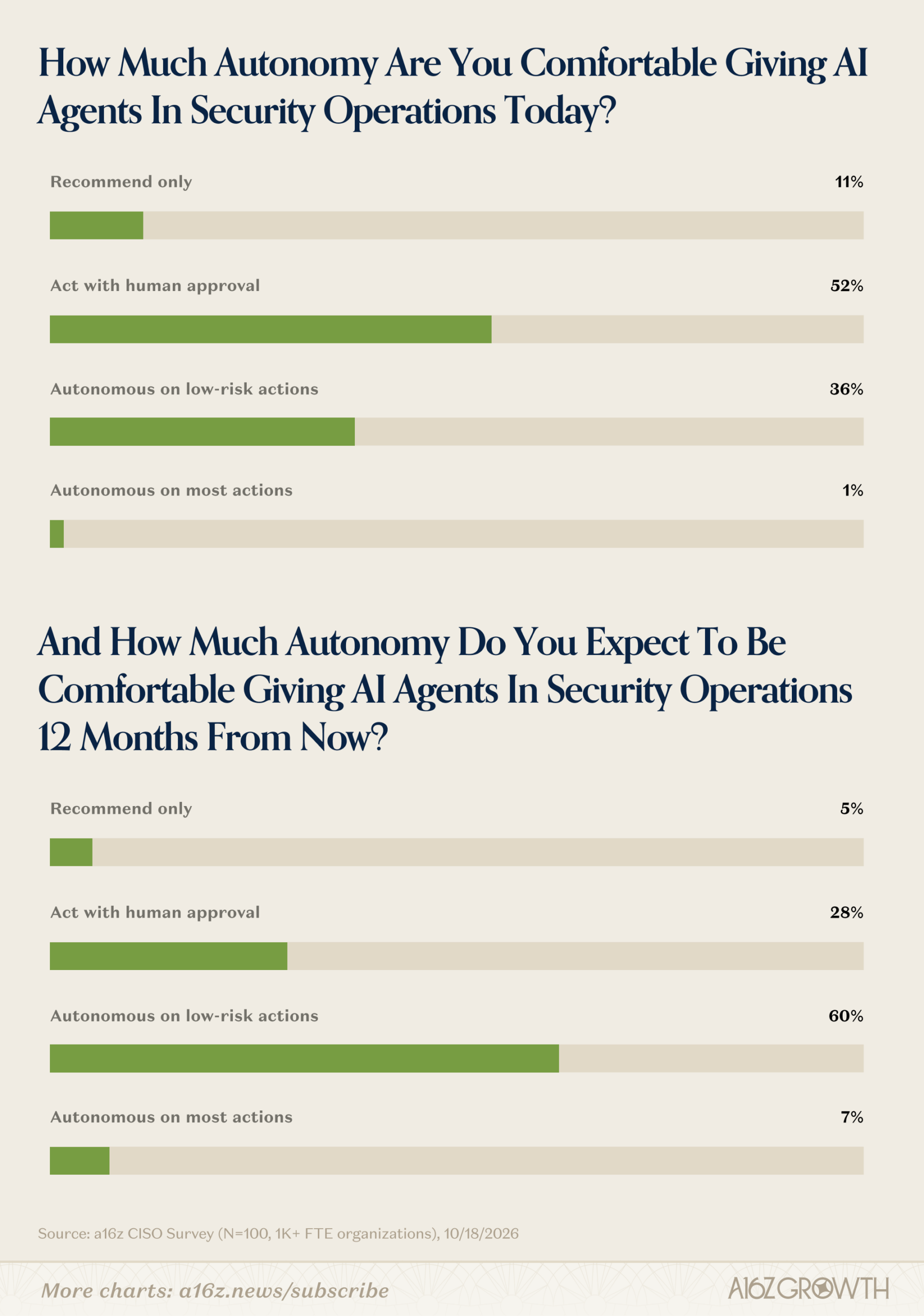
In a16z's October 2026 survey of 100 CISOs at companies with more than 1,000 employees, counting limited as well as broad production use, 92% report employee generative AI tools in production, 83% coding assistants or agents, and 55% MCP servers or other agent-to-application integrations.

Who was asked: 100 CISOs at companies with more than 1,000 employees

The base is security chiefs at large companies, chosen in a way the report doesn't describe.

Disclosure: Andreessen Horowitz, which ran the survey, led Armadin's Series B and invested in Neo, both named in the piece.

a16z, The New Security Agenda (Stephenie Zhang and Owen Colby), October 28, 2026 (a16z led Armadin's Series B and invested in Neo, both named in the piece) · Posted October 28, 2026 · Grade C

52%

Asked how much autonomy they are comfortable giving AI agents in security operations, 11% of the CISOs said recommend only, 52% act with human approval, 36% autonomous on low-risk actions and 1% autonomous on most actions; for 12 months from now, 5%, 28%, 60% and 7%.

Who was asked: 100 CISOs at companies with more than 1,000 employees

In security operations only, and what security chiefs at large companies say they are comfortable with, not what they measured.

Disclosure: Andreessen Horowitz, which ran the survey, led Armadin's Series B and invested in Neo, both named in the piece.

a16z, The New Security Agenda (Stephenie Zhang and Owen Colby), October 28, 2026 (a16z led Armadin's Series B and invested in Neo, both named in the piece) · Posted October 28, 2026 · Grade C

roughly one in four

OpenAI's December 2025 enterprise report says leading firms turn on connectors that give AI secure access to company data inside core tools, and that roughly one in four enterprises had not.

OpenAI doesn't state the base.

Disclosure: OpenAI's own report about its own customers.

OpenAI, The state of enterprise AI, 2025 report · December 7, 2025 · Grade B

63%

Menlo Ventures estimates that startups took 63% of the AI application market in 2025, up from 36% in 2024, while incumbents held 56% of the AI infrastructure market; its sizing excludes AI features built into existing software.

Menlo's sizing leaves out AI features built into existing software, the subject of this page, so it can't show how much AI incumbents deliver inside their suites.

Disclosure: Menlo Ventures invests in Anthropic and counts Databricks and Neon among its portfolio companies.

Menlo Ventures, "2025: The State of Generative AI in the Enterprise", December 9, 2025 · published December 9, 2025 · Grade C

What nobody publishes

No company on this page publishes all three numbers a buyer would need for its own AI: how many people come back to it, how often its output is accepted, and what people still check or redo. Microsoft counts seats and the mix of prompts, GitHub sorts users by how they work, Zoom counts paid users, Atlassian compares adopters with everyone else, Adobe counts companies that have tried its AI, and HubSpot defines a resolution its own way. The one acceptance rate here comes from a talk about one company's internal tool, and its speaker said retention suffered without giving a rate. On podcasts, sellers describe the checks they run, such as HubSpot's turn to customer satisfaction, Zapier's workflow diagrams and Kavak's evaluations, but none gives a rate for them.

The AI at Work Benchmark

Measure how your people actually use AI

Score your organization's practices, measure your people with an anonymous pulse, and see both against the published evidence.