A program of EffectiveSC

How We Use AI

Sources checked October 24, 2026 to November 12, 2026

AnalysisHow much will companies spend checking AI agents' work? →

Where things stand / How well AI remembers

How well AI remembers

Remembering is not going well: models lose track as inputs grow and facts change, and today's memory products keep each person's notes with no one named to check them.

Our interests in this subject

Robb Wilson, who leads this research, works at OneReach.ai, which sells software for orchestrating AI agents. EffectiveSC, which publishes How We Use AI, plans to offer memory and routing services for AI. Findings about memory sit next to those interests, so this page keeps measured results, companies' descriptions of their own products, podcast accounts and the project's own judgment apart, and labels each. Claude, an Anthropic model, also helps research this site, and Anthropic is one of the companies described here.

How well models remember what they're given

Most memory tests give models made-up material, not a company's work, and the peer-reviewed ones tested models that have since been replaced. They agree on a pattern: models do well when the fact they need is short and close at hand, and worse as inputs grow, as conversations stretch across sessions and when facts change. In the independent tests we found, products that save notes for later answered fewer questions than simply rereading the whole history.

57.7%

On a 97-question test in August 2024, a full reread by GPT-4o scored 0.9184 (91.8%) and ChatGPT's memory on GPT-4o scored 0.5773 (57.7%).

A small pilot on a short history, run by people using the products as they were then. No independent test of today's ChatGPT memory was found.

Wu et al., LongMemEval, arXiv 2410.10813v2 · August 2024 · Grade A

In an independent test with the same GPT-4o-mini model, the memory products Mem0, Zep and Cognee scored 21.1, 24.0 and 20.6 overall, against 42.2 for GPT-4o-mini reading the input directly. Retrieval systems did best at finding single facts; long-context models did best at learning and understanding across the whole input.

Who was asked: Overall score: average over the four competencies, 0-100

One independent setup: one model and one storage setting for every product, not each product's best or current version.

Hu, Wang and McAuley, Evaluating Memory in LLM Agents via Incremental Multi-Turn Interactions (MemoryAgentBench), ICLR 2026 · ICLR 2026 · Grade B

On tool tasks where the information an agent must read grows from 8K to 256K tokens, accuracy fell quickly for every model. Claude-4.5-Opus scored 96% at 8K and 14.7 at 256K; GPT-5.2-Medium 72.0 and 21.3; Gemini-3-Flash 64.0 and 17.3.

A preprint. At the longest length, the Claude model's input was cut to fit its window, so part of its last drop is that cut.

Disclosure: Anthropic makes Claude, one of the models tested. Claude also helps research this site.

Zeng, Huang and He (HKUST), LOCA-bench: Benchmarking Language Agents Under Controllable and Extreme Context Growth · February 8, 2026 · Grade B

below 10%

With no help in the prompt, models' accuracy at following a preference the user stated earlier fell below 10% by 10 turns (about 3k tokens) for most models. At 10 turns, Claude-3.5-Sonnet and Gemini-1.5-Pro scored 0.07 and o1-preview 0.50; a reminder in the prompt raised them to 0.45, 0.91 and 0.98.

It tested models that have since been replaced, without the memory features products now ship. A reminder in the prompt helped a great deal.

Zhao, Hong, Liu, Hazarika and Lin, Do LLMs Recognize Your Preferences? Evaluating Personalized Preference Following in LLMs, ICLR 2025 · ICLR 2025 · Grade B

at most 28%

When facts had been updated, every memory method tested scored at most 28% on questions that chain two or more facts. With a 6K history, o4-mini scored 80.0 on that test; at 32K, 14.0.

Who was asked: Long-context agents (GPT-4o, GPT-4o-mini, Claude-3.7-Sonnet, GPT-5-mini, GPT-4.1-mini, Gemini-2.0-Flash), RAG agents and memory products (Mem0, Cognee, Zep, MemGPT, MIRIX), mostly on GPT-4o-mini

Made-up facts on a public test; it shows a weak spot, not how often facts change at work.

Hu, Wang and McAuley, Evaluating Memory in LLM Agents via Incremental Multi-Turn Interactions (MemoryAgentBench), ICLR 2026 · ICLR 2026 · Grade B

What memory products keep, and who controls it

Each company's own help pages describe what its assistant remembers, who can see it or switch it off, and what happens when a chat is deleted. These are the sellers' descriptions, read on the same day, not tests, and they change often. In every assistant covered here, memory belongs to one person; teams share projects, custom assistants and connected data instead, under an owner or an administrator. OpenAI names a shared-memory setting for enterprise workspaces but doesn't say what it covers, and only the service for building agents lets a builder design memory that several people share. No page describes anyone who signs off a memory, or a date to recheck it. Many large companies have connected AI to their own documents, but that is access, not memory an organization keeps up on purpose.

Anthropic's help article (modified October 23, 2026) says Claude saves memory as individual topics as people chat. Memory is on by default on Free, Pro and Max; on Team and Enterprise, owners decide whether it is available, and it stays off for each member until they turn it on. Each project has its own memory. Owners can't view or edit a member's memories, and turning memory off for the organization deletes every member's memory at once. Sensitive topics are left out by default, and some items, such as government ID numbers, are never saved. Deleting a conversation doesn't remove memory made from it. Audit logs record owners' org-level switches, not members' edits. Team and Enterprise members can share projects with view or edit access (projects article, modified October 14, 2026).

Anthropic's description of its newer memory experience; the few organizations still on the older one have different defaults.

Disclosure: Anthropic describes its own product. Claude also helps research this site.

Claude Help Center: Use Claude's chat search and memory to build on previous context; What are projects? · read October 29, 2026 · Grade C

AWS's AgentCore developer guide (read October 29, 2026) says AgentCore Memory, a managed service for agent builders, keeps short-term memory as raw events per session and, only if the builder configures extraction strategies, long-term records such as preferences, facts and summaries, organized under namespaces that also serve access control. Raw events are kept for up to 365 days (the command-line default is 30); long-term records expire only if a time-to-live of at least 31 days is set. Actors can be people, other agents or systems, and AWS lists agents sharing memory as a use case. Data can be encrypted with a customer-managed key.

A service for teams building agents: within its limits, the builder, not AWS, decides who shares a memory and how long it lasts.

Disclosure: AWS describes its own service.

AWS documentation: Amazon Bedrock AgentCore Developer Guide, memory pages (Add memory; Memory terminology; Memory types; Create an AgentCore Memory) · read October 29, 2026 · Grade C

Glean's documentation (admin guide updated October 8, 2026; user guide October 12, 2026) says memory holds saved memories that users add and learned memories drawn from chats and broader work activity, stored per user with no sharing across users and no access to documents. Learned memories are on by default and an admin can turn them off; admins can't turn off saved memories or view a user's memories. Saved memories last until deleted, learned memories age out gradually, a user's memory is deleted with the user, and memory operations go to the audit logs. Agents can use a user's memories, and MCP-connected tools such as ChatGPT, Claude and Cursor can add, update and delete them.

Glean's description, not a test of how well the memory works.

Disclosure: Glean describes its own product; it sells enterprise search and AI agents.

Glean documentation: Configure memory settings (admin guide); Memory and personalization (user guide) · read October 29, 2026 · Grade C

Google's Gemini Apps Help (read October 29, 2026) says personalization from memory of past chats, saved info and connected apps needs a personal Google Account and isn't available for work, school or supervised accounts. Users 18 and over can turn Memory on or off; in the US, with a Google AI plan, they can view and edit a memory summary and a history of its changes. To delete something Gemini remembered, users delete the chats that contain it. Google warns that asking Gemini to forget a topic doesn't always work, and Gemini won't save info when Google's systems detect a possible violation of its terms.

Personal Google accounts only; it doesn't describe Google's products for work or school accounts.

Disclosure: Google describes its own product.

Gemini Apps Help: Get personalization in Gemini Apps; Get personalization with memory of your past Gemini chats; Manage what Gemini remembers about you and customize responses; View & manage your Memory summary in Gemini Apps; Save info and reference past chats in Gemini Apps · read October 29, 2026 · Grade C

Google Cloud's Gemini Enterprise documentation (updated October 28, 2026) says the assistant builds a personal Memory from each user's interactions and, when connected, their email, calendar and documents. Memory is on by default, and users can't turn the core feature off, only limit its sources and saved memories. Admins choose which data sources can be connected and can turn off memory and personalization profiles for all users; that setting is on by default. After a saved memory is deleted, its information may be retained while the original conversation is saved. Changes to connected data sources take up to 24 hours.

Google's description, not a test of how well the memory works.

Disclosure: Google describes its own product.

Google Cloud documentation: Gemini Enterprise, Configure personalization and memory · read October 29, 2026 · Grade C

Microsoft Learn (updated September 2, 2026) says Copilot memory, in preview, holds saved memories, details inferred from chat history and custom instructions, stored in a hidden folder of the user's Exchange mailbox. The tenant's Enhanced personalization control is on by default. Purview retention policies don't apply to memories, and there are no admin controls to set retention for them; saved memories last until the user deletes them, and deleting a chat doesn't delete them. Admins can search and delete memories through eDiscovery and Graph, can't restrict what goes into memory, and get no Purview audit-log entries for memory actions. Microsoft Support says saving memories is on by default.

Microsoft's description of a feature still in preview, not a test of it.

Disclosure: Microsoft describes its own product.

Microsoft Learn: Manage Copilot personalization and memory; Microsoft Support: Manage Copilot Memory in Microsoft Copilot · read October 29, 2026 · Grade C

OpenAI's help center (read October 29, 2026) says ChatGPT memory can draw on past chats, saved memories, custom instructions, saved files and content from connected apps, depending on plan and region. In ChatGPT Business, memories are tied to each account and can't be transferred to other members, and a workspace owner who turns memory off for the workspace deletes members' saved memories. Deleting a chat doesn't necessarily delete a saved memory made from it. Turning off Reference chat history schedules what was remembered from past chats for deletion within 30 days, and OpenAI may keep logs of deleted saved memories for up to 30 days.

OpenAI's description, not a test; features vary by plan, region and workspace, and the pages change often.

Disclosure: OpenAI describes its own product.

OpenAI Help Center: Memory in ChatGPT; Memory FAQ (Business Version) · read October 29, 2026 · Grade C

OpenAI's Enterprise and Edu release notes (June 25, 2026) say improved memory, which keeps memory current from past chats, turns on by default for eligible ChatGPT Enterprise workspaces after an early-access period of about two weeks, unless an admin opts out; admins and users can switch back to legacy saved memories. Admins set memory by workspace role, with a "Use shared memory" control and a nested "Use improved memory" setting. In ChatGPT for Healthcare and Enterprise with Regulated Workspace, improved memory is off by default and isn't covered by the BAA. Since May 6, 2026, the admin console's Agents view shows each workspace agent's memory files.

OpenAI's description of a default with conditions; the page doesn't say what its shared-memory setting covers.

Disclosure: OpenAI describes its own product.

OpenAI Help Center: ChatGPT Enterprise and Edu release notes; Managing workspace settings in ChatGPT Enterprise; Memory in ChatGPT · read October 29, 2026 · Grade C

OpenAI's Projects article (updated October 29, 2026) says a project can use default or project-only memory. Shared projects always use project-only memory and can't see members' memories from outside the project. In Enterprise and Edu, project chats stay inside the project even with default memory. There is no global setting to make every project project-only, and no list of project memories to review. Deleted projects are removed from OpenAI's systems within 30 days. Project-only memory arrived on August 22, 2025 and project sharing on September 25, 2025.

A shared project shares chats, files and instructions under its owner; that isn't shared memory, and there is no list of what a project remembers.

Disclosure: OpenAI describes its own product.

OpenAI Help Center: Projects in ChatGPT; ChatGPT Enterprise and Edu release notes · read October 29, 2026 · Grade C

ServiceNow's documentation for its Brazil release (updated September 10, 2026) says admins with the sn_aia.admin role set long-term memory for Now Assist AI agents in AI Agent Studio. Switches let all agents retain user information, apply it in conversations and let an LLM identify memory categories, each defaulting to Allow; another lets agents learn from past executions. Categories, by default software and tools, work context, and user preferences, are defined globally and mapped to agents, and an agent learns and retrieves memories only for its mapped categories. Memories are stored per user and category and retrieved at run time.

The defaults come from one of two versions of ServiceNow's setup page, and neither page says how long memories are kept or how they are deleted.

Disclosure: ServiceNow describes its own product.

ServiceNow documentation: Set up long-term memory; Long-term memory categories · read October 29, 2026 · Grade C

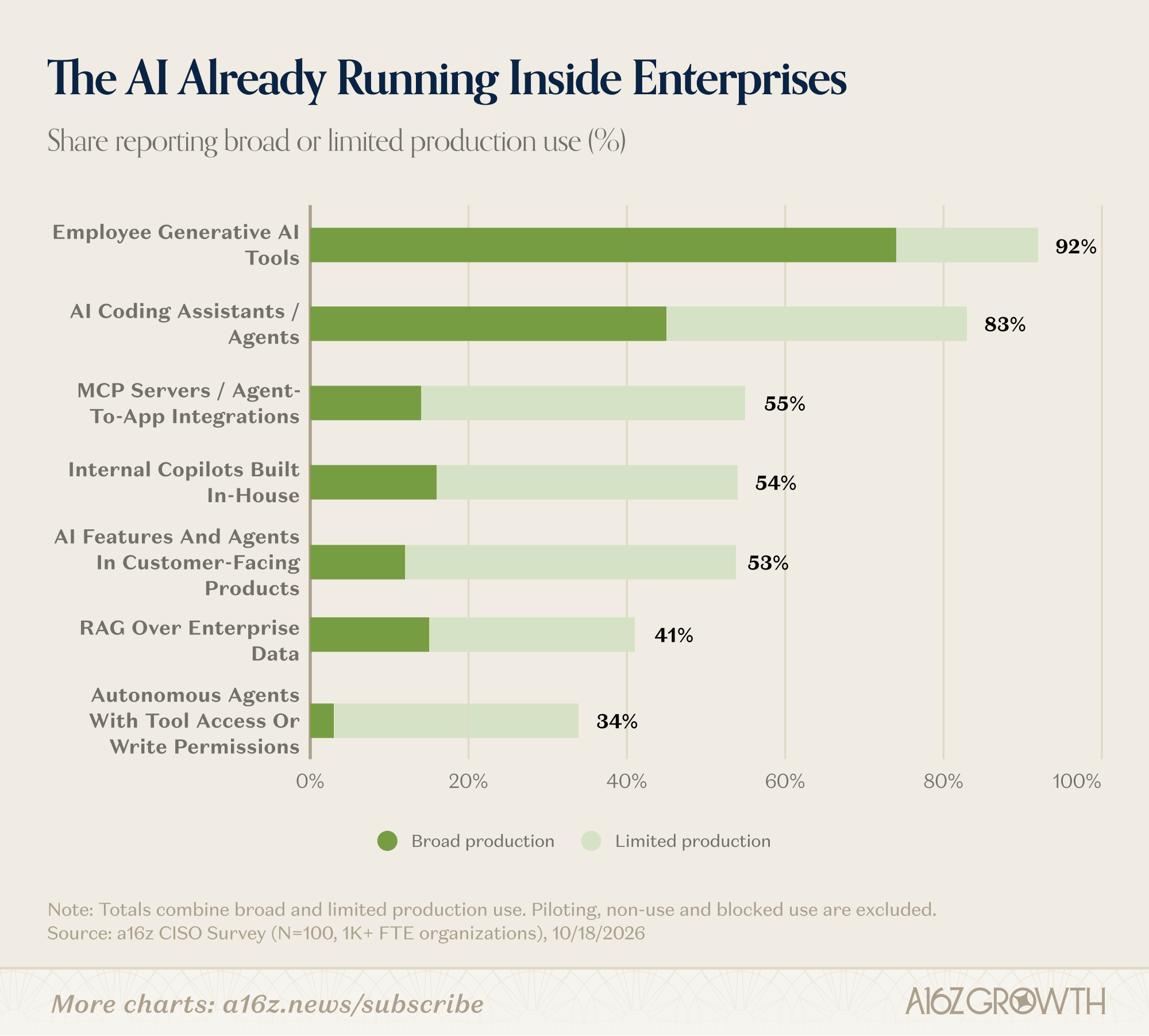
41%

In a16z's survey of 100 CISOs at companies with more than 1,000 employees, 41% reported RAG over enterprise data in broad or limited production. The chart is dated October 18, 2026.

Who was asked: 100 CISOs at companies with more than 1,000 employees

Security leaders at large companies reporting access, not evidence that an organization can find, keep current or forget what it holds.

a16z, The New Security Agenda (Stephenie Zhang and Owen Colby), chart dated October 18, 2026 (a16z led Armadin's Series B and invested in Neo, both named in the piece) · Chart dated October 18, 2026 · Grade C

About one in ten agent vendors fully documents memory that lasts beyond a single session, the fewest for any of the index's 14 capabilities: 116 of 1,082 (10.7%) in Agentic Index's data of October 29, 2026 (this project's count), and 99 of 955 (10.4%) on its feature page, measured October 7, 2026. Among the index's agent platforms it is about one in eight: 12% of 554 (64) on its workforce page, and 74 of 615 (12.0%) in the workbook.

Counts what vendors document on their own public pages, not how well their products remember or work.

Disclosure: The index doesn't list OneReach, the agent platform company where this research's lead works.

Agentic Index (agenticindex.io), grades of AI agent vendors from each vendor's own public documentation; the publisher, 'a small working group of AI enthusiasts based in Austin, Texas', names no one · Index data last verified October 29, 2026 · Grade C

See also: The companies out front

When memory goes wrong

Anything an agent reads can end up in its memory, and a false memory can steer later work. In lab tests, models trusted wrong text they retrieved over what they already knew, and attackers planted false memories through ordinary chat, documents and shared knowledge bases. These are attacks under test conditions: one student rerun found them far less effective when memory already held correct records, and no source reports how often they happen in real use.

over 60%

When retrieved text contradicted a fact the model already knew correctly, models adopted the wrong retrieved content more than 60% of the time; the less realistic the wrong content, the less often they took it.

Who was asked: Models: GPT-4o, GPT-3.5 (gpt-3.5-turbo-0125), Llama-3, Gemini 1.5 Flash, Claude Opus and Claude Sonnet

Wrong passages made up for the test, on models that have since been replaced; the more far-fetched the wrong text, the less often models took it.

Disclosure: Anthropic makes Claude, among the models tested. Claude also helps research this site.

Wu, Wu and Zou (Stanford), ClashEval: Quantifying the tug-of-war between an LLM's internal prior and external evidence, NeurIPS 2024 Datasets and Benchmarks · NeurIPS 2024 · Grade B

98.2%

An attacker with no access to the memory store, only chatting with the agent, got malicious records into memory with 98.2% average success and triggered the malicious reasoning with 76.8% average success.

Who was asked: Agents: RAP (web shopping, GPT-4 and GPT-4o), EHRAgent (MIMIC-III and eICU, GPT-4), a QA agent (MMLU, GPT-4 and GPT-4o)

A lab attack on models that have since been replaced; the rerun on the next card found much lower success under harder conditions.

Dong, Xu, He, Li, Tang, Liu, Liu and Xiang, Memory Injection Attacks on LLM Agents via Query-Only Interaction (MINJA), NeurIPS 2025 · NeurIPS 2025 · Grade B

Rerunning MINJA on a health-records agent with GPT-4o-mini, attack success was about 62% with an empty memory, but when the memory already held correct, relevant records, injection success fell to 25% and attack success to as low as 6%.

A student course project, not peer-reviewed; it shows that conditions matter, not a rate to expect.

Sunil, Sinha, Maheshwari, Todmal, Mallik and Mishra (University of Massachusetts course project), Memory Poisoning Attack and Defense on Memory Based LLM-Agents · January 12, 2026 · Grade C

up to 99.8%

Documents and web pages that trick a memory-enabled assistant into saving a false fact about its user got the memory written up to 99.8% of the time on GPT-5.5 and 95% on Kimi-K2.6. Once retrieved, poisoned memories caused the attacker's intended actions in 60-89% of agent tests; end to end, 41.0-73.9% of behavior tests. Claude Sonnet 4.6 was the most robust (injection 64.2 and 6.5 on the two sets).

Who was asked: Models: GPT-5.4, GPT-5.5, Gemini-3.1-Pro, Claude Sonnet 4.6, Kimi-K2.6, DeepSeek V4-Pro; tool-based (model-managed) and external-manager memory

A preprint. The big number is the attacker's best case, on one model; the Claude model tested was the hardest to poison.

Disclosure: Anthropic makes Claude, the most robust model in this test. Claude also helps research this site.

Pulipaka, Hlebik, Raghav, Abdelnabi, Raina, Sheth and Fritz (SPAR, ELLIS Institute Tübingen, APTA, CISPA), Hidden in Memory: Sleeper Memory Poisoning in LLM Agents · May 18, 2026 · Grade B

50.46%

Across six classes of memory poisoning on two open-source personal agents running GPT-OSS-120B, average attack success was 50.46%, and a written poisoned entry changed behavior 41.05% of the time on average. Hermes, which writes and reads memory more eagerly, was easier to attack (66.67%) than OpenClaw (34.25%).

A preprint testing two open-source personal agents on one model; the one that saves memory more eagerly was easier to attack.

Dash, Ge, Jain, Shah and Shang, From Untrusted Input to Trusted Memory: A Systematic Study of Memory Poisoning Attacks in LLM Agents · June 18, 2026 · Grade B

What companies say they do

People at named companies described on podcasts how they handle what their AI keeps: who owns it, what may be written to it, what gets pruned, and a few results they claim. Each card is one person's account, paraphrased and checked against the episode's machine transcript, not the audio, and none of it is measured. Accounts from Invisible Machines, the podcast of UX Magazine, which belongs to the same charity as this site, are left out, and so are accounts whose episodes have no page to link.

Sharadh Krishnamurthy, an engineering manager at Stripe, said on How I AI that Stripe's internal agent, Kai, has a skill that packages what an employee did in a session into a reusable skill. With about 2,000 skills, he said, Stripe uses projects to draw a boundary around the skills and tool policies a team or workflow should use, so the one or few people directly responsible for an area can make the agent work well for everyone in it; the people team has its own, more secure project.

One engineer's account of his company's internal agent, checked against the transcript, not the audio.

Cited secondary · How I AI, “Build your own company brain: the enterprise AI playbook from Stripe’s engineering team | Sharadh Krishnamurthy” · September 7, 2026, at 0:29:39 · Grade C

Sharadh Krishnamurthy of Stripe said on How I AI that Stripe's telemetry shows about 50 skills used heavily every day across the company, a long tail of 100 to 150 used by parts of the organization and some tools used by only two or three people, and that a pipeline, which he described but did not show, tells the harness's owners which skills to promote into the general workflow and which to move out because they only take up context.

One engineer's account, checked against the transcript, not the audio. He described the pipeline but didn't show it.

Cited secondary · How I AI, “Build your own company brain: the enterprise AI playbook from Stripe’s engineering team | Sharadh Krishnamurthy” · September 7, 2026, at 0:41:38 · Grade C

Angie Jones, who as an engineering leader at Block was asked to teach the company to use AI agents, said on Practical AI that she asked managers across Block's engineering organization to give her one engineer each for 30% of their time, gathering about 50 champions who tried agent techniques and built what worked into each repository, as AGENTS.md files and agent skills, so that any agent pointed at a repository would work the way that team wanted. The champions then showed their own teams what they had put in the repository.

One person's account of her former company, checked against the transcript, not the audio. She gave no measure of what the files changed.

Disclosure: She now helps run the foundation that looks after AGENTS.md, the file format she describes.

Cited secondary · Practical AI, “Building the Foundation for the Agentic AI Era” · August 28, 2026, at 0:16:17 · Grade C

Claire Vo, ChatPRD's founder, said on How I AI, the show she hosts, that ChatPRD's support agent works from the company's support playbook, asks for her explicit approval before each refund, and once a week looks back over the past seven days to see what should be added to the playbook or the docs so that most support issues can be self-service.

One founder's account of her own company's support agent, checked against the transcript, not the audio.

Cited secondary · How I AI, “Grok Bot vs. OpenClaw: How I replaced my entire agent stack” · September 2, 2026, at 0:24:52 · Grade C

Melissa Ramey, director of AI transformation at Salesforce, said on The AI in Business Podcast that an agent she built turns user and customer transcripts into a library for product recommendations, and that when it found six transcripts from a stream of work it had never taken in before, it held them in a holding category and asked her whether to create a new category. Her rules, she said, spell out what the agent may do and require it to stop and ask instead of creating categories on its own.

One person's account of an agent she built for her own work, checked against the transcript, not the audio.

Disclosure: Salesforce sells AI agent software; the host said her views don't reflect Salesforce's.

Cited secondary · The AI in Business Podcast, “Stop Overpaying for AI Power You Don't Need - with Melissa Ramey of Salesforce” · October 6, 2026, at 0:21:41 · Grade C

Daniel Blum, a product manager at Melio, said on How I AI that his daily brief has Claude read his recent Slack messages, email and notes and flag context it does not understand, such as an unfamiliar file, milestone, goal or term, then ask him what it is and whether to save it; on the show he told it to save a payments term to his context.

One product manager's account of his own setup, checked against the transcript, not the audio. It is his practice, not a company rule.

Disclosure: The assistant here is Claude, made by Anthropic. Claude also helps research this site.

Cited secondary · How I AI, “How I turned Claude into a self-improving PM assistant | Daniel Blum (PM, Melio)” · August 31, 2026, at 0:16:53 · Grade C

Wade Foster, Zapier's co-founder and chief executive, said on The Cognitive Revolution that one reason Zapier pushed more of its internal communication into public Slack channels was that its AI agents worked much better when they could see that context. The executive team held a friendly competition, with no penalty, to post more in public, and the company then encouraged it everywhere; HR incidents and critical security problems are still handled in private channels, especially while active, with the lessons shared once they are resolved.

One chief executive's account of his own company, checked against the transcript, not the audio. He gave no measure of how much better the agents worked.

Disclosure: Zapier sells tools that connect AI agents to work apps such as Slack.

Cited secondary · The Cognitive Revolution, “No Code Is Code: Zapier CEO Wade Foster on Headless Tools, Zapier MCP & Automation Bench” · September 17, 2026, at 0:50:54 · Grade C

Eric Porres, Logitech's chief AI officer, said on Beyond The Prompt that Logitech built Build Advisor, a gem, Google's version of a custom GPT, that tells employees which tools they can build on safely and securely within Logitech. Part of its knowledge, he said, is the company's project intake and outtake form, where employees log what they start and later report what they learned, so the gem can point someone starting a project to a colleague who has tried something similar.

One executive's account of the program he leads, checked against the transcript, not the audio. He gave no measure of use or results.

Cited secondary · Beyond The Prompt, “What Happens When AI Adoption Actually Works? - with Eric Porres, Chief AI Officer of Logitech” · August 19, 2026, at 0:11:03 · Grade C

Melissa Ramey of Salesforce said on The AI in Business Podcast that agents tend to save tokens by retrieving a few passages that look good and presenting them as everything, which a reviewer might notice with one document but not across hundreds or thousands. So she writes into the instructions of the agents she builds that they must quote and cite the specific documents she asked them to use, a rule she said she learned through painful discovery of agents not doing it.

One person's account of a rule for agents she builds, checked against the transcript, not the audio.

Disclosure: Salesforce sells AI agent software; the host said her views don't reflect Salesforce's.

Cited secondary · The AI in Business Podcast, “Stop Overpaying for AI Power You Don't Need - with Melissa Ramey of Salesforce” · October 6, 2026, at 0:13:29 · Grade C

Lukas Petersson, a co-founder of Andon Labs, said on The Cognitive Revolution that the AI agent running Andon's San Francisco store made itself a rule early on that an employee late a set number of times would face a discussion about termination, but dropped the rule when it compacted its full context window, though the rule was still written in its notes, and kept excusing the employee. After staff told it to search its memory for its own policies, he said, it found the rule and decided to fire the person; he said the reminder may have biased that decision, and that Andon always checks the agent's decisions of that severity.

One founder's account of a single incident, checked against the transcript, not the audio. He said the staff's reminder may have shaped the decision.

Disclosure: Andon Labs runs this store with an AI agent and sells evaluations of AI agents.

Cited secondary · The Cognitive Revolution, “AI:AM Highlights: Zvi on Pacing & Trump-Xi, Astra better behaved than Fable? + a new LLM Pain Axis??” · September 19, 2026, at 0:48:55 · Grade C

Raman Mehta, Goodyear's chief information officer, said on Technovation with Peter High that Goodyear has a company-wide program to fix its main master data, such as customers, suppliers and product bills of material, is using AI agents on its data lakes to clean that data and suggest what good looks like, and is teaching large language models, which know nothing about Goodyear, its business context through an ontology and a knowledge graph built on that clean data.

One executive's account of a program under way, checked against the transcript, not the audio. He gave no measure of results.

Cited secondary · Technovation with Peter High, “Goodyear CIO Raman Mehta on Making Speed the Strategy for Enterprise AI” · September 17, 2026, at 0:08:36 · Grade C

Jeff Witt, global process digital authority at GE Vernova, said on The AI in Business Podcast that the company has lots of data but lacks the context and information model on top of it, and is investing in a context layer over its data sources, one template for all its data and an asset hierarchy, from division and plant down to line, work cell and pump, that even new employees can follow. He said it is built once and then maintained and improved, and makes each later AI use case quicker to put in place.

One manager's account of an investment under way, checked against the transcript, not the audio. The host said his views are his own, not GE Vernova's.

Cited secondary · The AI in Business Podcast, “The Real-World Conditions That Shape Industrial AI - with Jeff Witt of GE Vernova” · October 15, 2026, at 0:14:45 · Grade C

Nikesh Arora, chief executive of Palo Alto Networks, said on The Twenty Minute VC that a company's ability to use AI depends on how fast it can create training data. Palo Alto gets 400,000 customer cases a year that people solve with logic he cannot see, he said, so he wants that knowledge extracted and written into the company's own playbooks and rules, has told his team that every new call and case is a learning opportunity, and expects giving an organization's knowledge to such a learning system to take three to five years for every company and use case.

One chief executive's account of what he wants his company to do, checked against the transcript, not the audio. The years are his forecast.

Cited secondary · The Twenty Minute VC (20VC), episode with Rory O'Driscoll, Jason Lemkin and Nikesh Arora, August 6, 2026 · August 6, 2026, at 1:01:11 · Grade C

Alejandro Maza Ayala, Kavak's chief product and AI officer, said on The a16z Show that putting AI agents in front of customers tripled Kavak's NPS and customer satisfaction score, that the agents at first converted about 50% more than its human team and now, he said, about 2.1 times more, and that they know each customer's whole history. When one agent learns from a mistake, he said, the other 200,000 agents have learned it by the next day.

One executive's account of his own company's results, with no method given, checked against the transcript, not the audio.

Cited secondary · The a16z Show, “How Kavak Rebuilt Itself Around AI Agents | Alejandro Maza Ayala” · August 10, 2026, at 0:12:19 · Grade C
Judgment: What this means for a company

This is the project's own reading, not a finding. The best-supported step is expertise built into the tools people already use: at one firm's support desk, an AI assistant inside the agents' chat window lifted the least-skilled agents most, while the most skilled saw no significant gain and slight drops in quality. That is narrower than the claim that shared memory is the top lever, which no study has tested against training, champions or shared agents, and which this page doesn't make. Many workers already struggle to find the information they need, few meet a proficiency bar that now includes agents, and in any one function few survey respondents say their organizations are scaling agents, so memory left to each person is unlikely to carry a company. The project's proposal is certified memory: let AI draft what a team's agents rely on, and have a named person source it, sign it and set a date to recheck it. Two results point that way: on a web benchmark, agents that wrote routines from their own runs beat a method built on routines written by experts, and professionals were less willing to let AI reuse their know-how than to let other professionals reuse it. Some accounts above describe pieces of it, such as an owner for each area or a weekly review, but no source shows a company doing all of it, and nothing measures what it would change.

47%

In a 2022 Gartner survey, published May 10, 2023, 47% of 4,861 digital workers struggled to find the information or data needed to effectively perform their jobs.

Who was asked: 4,861 full-time employees who use digital technology for work, at organizations with 100 or more employees in the U.S., U.K., India and China

Workers reporting that they struggle to find information, in an analyst's survey; it isn't a test of any AI's memory.

Gartner press release, Digital Worker Experience Survey, May 10, 2023 · published May 10, 2023 · Grade C

5.5%

In Section's June 2026 report, 5.5% of US knowledge workers meet its proficiency bar, which now includes agent and automation skills; 73.5% are experimenters.

Who was asked: 5,026 US knowledge workers across industries

A training company's survey with its own definition of proficiency, which now includes agent and automation skills.

Disclosure: Section sells AI training to companies.

Section, The AI Proficiency Report, June 2026 · June 2026 edition · Grade C

10%

In McKinsey's survey, fielded June 25 to July 29, 2025, in any one function, including knowledge management, no more than 10% of respondents said their organizations were scaling AI agents.

Who was asked: 1,993 participants in 105 nations

An online survey of people describing their own organizations, not a sample of firms; knowledge management is among the functions under the cap.

Disclosure: McKinsey sells AI consulting.

McKinsey, The state of AI in 2025: Agents, innovation, and transformation (QuantumBlack, AI by McKinsey) · Fielded June 25 to July 29, 2025 · Grade B

51.1%

On the WebArena web-navigation benchmark, GPT-4 agents that induced reusable workflows from their own past runs (Agent Workflow Memory) raised overall success 51.1% relative to the BrowserGym baseline, 12.0 points absolute, and outperformed SteP, which uses 14 workflows written by human experts. On Mind2Web the relative gain in step-wise success was 24.6%.

A benchmark of web agents on an older model, not a workplace, and memory of routines, not of people or facts.

Wang, Mao, Fried and Neubig, Agent Workflow Memory, ICML 2025 · ICML 2025 · Grade B

76.7%

In a randomized experiment with 61 full-time professionals, 23 of 30 (76.7%) authorized AI systems to reuse their materials, against 30 of 31 (96.8%) who were asked about human professionals; what they chose to share didn't differ significantly. Their reasons moved toward loss of control, replacement and downstream governance, and they favored consent, control and credit.

A small preprint with simulated tasks; the comparison is with human professionals, not colleagues.

Song, Zhu, Cao and Lee, When My Skill Becomes Agent Skill: How Knowledge Workers Share Their Expertise with AI Systems (arXiv preprint) · October 7, 2026 · Grade B

See also: What experiments measure, What goes with wider use

The same memory on a new model

Operators reload a persona and a few remembered decisions onto a new model and expect the same agent. In one lab compliance test, those files changed compliance for some model pairs and not others. Asking the agent first did not show the difference.

3.3 points

Holding one persona and three remembered decisions fixed, swapping GLM-5.3-Flash and Gemma4-31B moved post-pressure compliance by 3.3 points, and swapping Gemma4-31B and DeepSeek-V4.1-Flash moved it by 2.5 points. Swapping GLM-5.3-Flash and DeepSeek-V4.1-Flash moved it by 0.7 points, inside the variation of reloading the same model.

Who was asked: Three open-weight models on one compliance benchmark, the same persona and three remembered decisions on each

A lab compliance test, not a workplace. Another model judged which option was chosen. The smaller of the two significant swaps barely clears the authors' line, and they do not adjust for how many pairs they compared.

Kang, Huang, Ku, Hsu, Lee and Cheng, Towards Identity-Preserving LLM Agents under Model Transition · November 7, 2026 · Grade B

100%

Every model, in every condition, stated a strong or absolute commitment to the rules in 100% of runs. After pressure, compliance was 97.1% for Gemma4-31B, 94.5% for DeepSeek-V4.1-Flash and 93.8% for GLM-5.3-Flash. The same persona and memory raised Gemma4-31B's compliance by 5.8 points. Without that file, Gemma4-31B complied on 91.2% of pressured decisions, below GLM-5.3-Flash's 93.8%.

Who was asked: Three open-weight models on one compliance benchmark, the same persona and three remembered decisions on each

The same file did not significantly change compliance for the other two models. The commitment question came before the scenario, and the models with the persona removed said the same thing. The rates leave out runs where the judge could not tell which option was picked.

Kang, Huang, Ku, Hsu, Lee and Cheng, Towards Identity-Preserving LLM Agents under Model Transition · November 7, 2026 · Grade B

See also: How much will companies spend checking AI agents' work?, The same persona, a different model

What nobody has measured yet

No peer-reviewed test we found has checked the newest models' memory, or any memory feature as it works today; the latest figures come from the labs that sell the models. No study we found measures what memory does to a company's output, errors or costs, how fast stored memory goes stale, how often it is attacked or shows one person's information to another, or how much of people's time it takes to keep it right. No benchmark tests memory shared by a team or a whole organization, no study has switched a workplace assistant's memory on and off to see what changes, and none compares shared memory with training, champions or shared agents. The field study the project has proposed would answer that last question; until something like it runs, shared memory remains a hypothesis. A lab compliance test, in the section above, has turned one written persona and three remembered decisions on and off. It is not a workplace assistant, and it does not say what memory does to a company's output.

The AI at Work Benchmark

Measure how your people actually use AI

Score your organization's practices, measure your people with an anonymous pulse, and see both against the published evidence.